
Indoor Padel Clubs in the U.S.: How to Convert a Warehouse (Checklist)
- Padel One Courts

- Feb 22
- 5 min read
Updated: May 11
A Feasibility Guide for Club Operators, Developers, and Padel Facility Owners
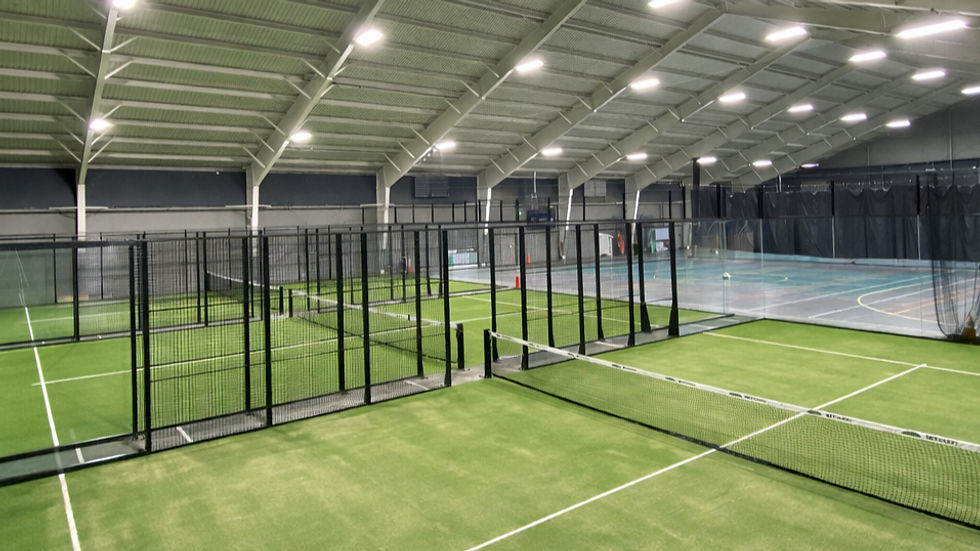
Indoor padel clubs are on the rise. They enhance the one metric that matters most for facility economics: reliable utilization and occupancy. Weather-proof scheduling makes leagues, coaching, memberships, corporate events, and peak-hour programming easier to plan—and sell.
A warehouse can be a great path to market, but only if the building passes a few non-negotiable tests. This checklist is designed to help you evaluate a space like an operator, not a renter.
Quick Feasibility Snapshot
Before you spend money on plans—or sign a lease—confirm these core requirements:
Pass/Fail Requirements
Court dimensions: A padel court measures 10m wide × 20m long (interior) with a 0.5% tolerance.
Minimum clear height: 6m minimum throughout the court with no obstructions; 8m is suggested for new facilities.
Planning footprint: Minimum recommended 70 ft × 37 ft; tournament-ready planning 70 ft × 45 ft.
Slab readiness: Floor condition must be suitable for install (flat/level, dry, repairable).
Electrical: Sufficient capacity for lighting plus HVAC/dehumidification loads.
Common Deal-Breakers
Columns: You need enough clear space between columns to fit the full court footprint. If a column or obstacle lands within the court area, the court cannot be installed there.
Flooring issues: Warehouse floors are usually thick concrete, but many are not in install-ready condition and require prep (cracks, joints, moisture, flatness/levelness).
Parking and zoning requirements: Depending on the area and the building’s prior use, the site may or may not be suitable for a sports facility from a zoning and parking standpoint.
What Makes a Warehouse Conversion Succeed
The best indoor clubs don’t win on “number of courts” alone. They win by designing for:
Throughput: Clean circulation and easy scheduling flow.
Comfort: Temperature and humidity control that stays consistent.
Experience: Lighting that feels premium and plays clean.
Flexibility: Space for coaching, events, and social time.
The Indoor Padel Club Warehouse Conversion Checklist
1) Clear Height + Ceiling Obstructions (The First Filter)
Padel requires overhead play and high lobs. If the building is tight overhead, the facility will feel compromised.
What to Verify
True clear height across the full court area (not just one point).
All obstructions: HVAC ducts, sprinkler mains, beams, hanging lights, signage.
Whether services can be rerouted to keep the court envelope clean.
Minimum Standard
6m minimum free height throughout the court; 8m suggested for new facilities.
2) Column Grid + Court Bay Efficiency (Where ROI Is Won or Lost)
Column layout determines whether the space works at all—and how many courts you can fit.
You cannot place a court if a column or obstacle lands within the court footprint. The column grid also determines whether you can build repeatable court bays with clean circulation, or whether you’ll end up with dead space and awkward pathways.
What to Verify
Courts can fit in repeatable bays (layout consistency reduces build complexity).
Safe spectator and player movement (no “walking through play” circulation).
Space for value-driving zones: lounge, pro shop, coaching area, storage.
Red Flags
Courts only fit diagonally.
Dead zones you can’t monetize.
Columns inside high-traffic paths.
3) Slab Condition + Floor Readiness (The Hidden Deal-Breaker)
Your slab is the foundation for long-term performance and safety. Many warehouses have strong slabs, but they may not be flat enough, dry enough, or clean enough for installation without prep work.
What to Verify
Crack patterns and joint condition.
Moisture risk (especially in humid markets).
Flatness/levelness documentation where possible.
How to Evaluate Professionally (Without Guessing)
If the project is serious, have a qualified contractor perform a floor survey and document flatness/levelness.
A common industry approach is to quantify slab profile using FF (floor flatness) and FL (floor levelness) measurements, which helps confirm whether remediation (grinding/overlay) is required before installation.
4) Access Routes + Install Logistics (Schedule and Cost Control)
Indoor padel installation includes heavy structure and glass. Logistics can quietly become the biggest cost driver.
What to Verify
Truck access, loading space, turning radius.
Door sizes and interior travel path for materials.
Staging area that doesn’t block egress or operations.
Red Flags
No staging zone.
Tight interior routes requiring manual handling.
5) HVAC, Ventilation, and Humidity (The Comfort Multiplier)
Indoor padel is a premium experience when the facility is comfortable all day. Comfort directly impacts retention and repeat play—especially in Florida.
What to Verify
HVAC sized for peak occupancy and heat loads.
A real humidity plan (especially Florida/coastal markets).
Ventilation aligned to sports “play area” expectations.
6) Lighting (Playability + Premium Perception)
Lighting is one of the easiest ways to separate a premium indoor club from a basic facility. It affects visibility, safety, and the overall “feel” of the venue.
What to Verify
Lighting levels appropriate to your use case (training vs. competition).
Uniformity across the full court (avoid hot spots and dark zones).
Placement designed to minimize glare and reflections on the glass.
Maintenance access for fixtures over time.
7) Permitting + Life Safety (Don’t Treat It as an Afterthought)
Converting a warehouse into a sports venue can trigger code requirements that affect exits, restrooms, accessibility, fire protection, and occupancy loads.
What to Verify Early
Expected occupancy classification path.
Egress plan, travel distances, exit counts.
Accessibility requirements.
Parking needs (zoning + minimum counts).
Sprinkler/fire alarm upgrade scope if required.
Florida Addendum
If your project is in Florida, plan for climate realities from day one:
Humidity control is core infrastructure, not an upgrade.
Coastal exposure may require higher attention to durability and maintenance planning.
Build realistic permitting timelines into your schedule.
We serve all of Florida, including: Miami, Fort Lauderdale, West Palm Beach, Orlando, Tampa, St. Petersburg, Clearwater, Jacksonville, Naples, Fort Myers, Sarasota, Bradenton, Port St. Lucie, Melbourne, Daytona Beach, Gainesville, Tallahassee, Pensacola, Panama City, and surrounding areas.
Pickleball Operators: How to Turn Inbound Interest Into a Winning Expansion
If you’re getting calls from pickleball businesses, that’s a signal: operators are looking for the next premium court product.
How to Position Padel
Premium tier expansion: Padel becomes the elevated racquet offering inside your facility mix.
Programming engine: Leagues, coaching, and corporate events are easier to sell indoors.
Experience differentiation: A distinct product that feels new, social, and higher-end.
The strongest facilities don’t pick one sport—they build a portfolio that increases total utilization and spend per member.
What to Do Next
Before lease signature or design spend, do a feasibility review that confirms:
Clear height and ceiling obstruction mapping.
Court fit and circulation concept (court bays and social/program space).
Slab readiness (including a documented flatness/levelness approach if needed).
HVAC/humidity plan aligned to a sports “play area” environment.
Lighting targets aligned to indoor padel expectations.
Permitting/life-safety scope for change of use.
Frequently Asked Questions (FAQ)
What is the minimum ceiling height for indoor padel?
Minimum free height is 6m throughout the court, with 8m suggested for new facilities.
What are the official padel court dimensions?
A padel court is 10m × 20m (interior) with a 0.5% tolerance.
How bright should indoor padel lighting be?
Indoor guidance commonly referenced: 750 lux (national/international) and 300 lux (local/training/recreational), with uniformity requirements.
Why does slab quality matter so much?
Because it drives safety, finish performance, and long-term durability; documenting flatness/levelness helps quantify readiness and remediation needs.
If you’re considering building a padel court in Florida or anywhere in the U.S., here are the next simple steps:
➡️ Request a Custom Quote – Fastest way to get an accurate estimate tailored to your site.
🌴 Florida Owner? Read our article on Hurricane-Resistant Padel Courts for coastal engineering standards.


 Get a Free Quote